
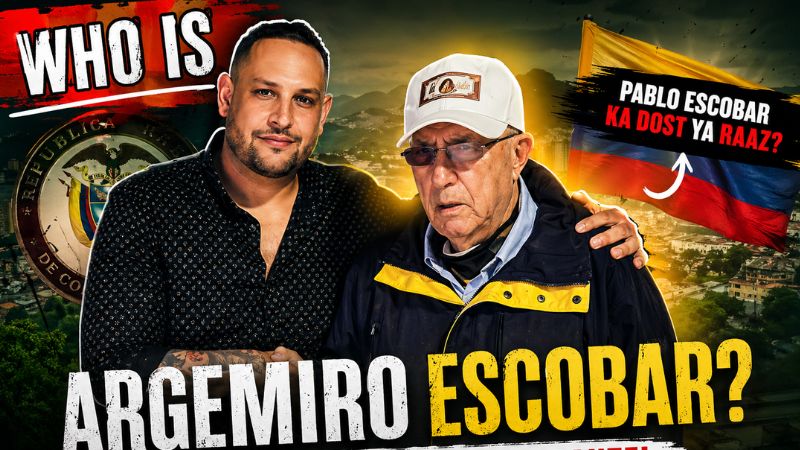
When people hear the name Pablo Escobar, they often imagine a life full of danger, power, and massive wealth. His story has been told again and again in movies, documentaries, and news reports. But very few people stop and ask about the family behind him—especially his lesser-known brother, Argemiro Escobar. Unlike Pablo, Argemiro never chased fame or influence. He lived quietly, far away from the chaos that surrounded his brother’s name.
So, who is Argemiro Escobar, and why is his story rarely discussed? While one brother built a criminal empire that shook the world, the other chose a simple and peaceful path. Argemiro’s life feels almost like the opposite side of the same coin. He stayed focused on honest work, avoided media attention, and remained out of trouble. This contrast makes his story not just interesting—but also important for understanding the full picture of the Escobar family.
Quick Bio of Argemiro Escobar
| Category | Details |
| Full Name | Argemiro Escobar Gaviria |
| Date of Birth | 1939 |
| Date of Death | 2020 |
| Age at Death | 81 years old |
| Birthplace | Colombia |
| Nationality | Colombian |
| Ethnicity | Latino (Colombian) |
| Profession | Schoolteacher |
| Education | Likely completed formal education in Colombia (exact details not publicly available) |
| Famous For | Being the older brother of Pablo Escobar |
| Father | Abel de Jesús Escobar |
| Mother | Hermilda Gaviria |
| Siblings | Pablo Escobar, Roberto Escobar, and others |
| Family Background | Came from a modest rural Colombian family |
| Known Involvement in Crime | None – avoided all criminal activities |
| Relation to Medellín Cartel | No involvement with the Medellín Cartel |
| Personality | Known to be private, disciplined, and law-abiding |
| Public Profile | Very low – stayed out of media and public attention |
| Residence | Colombia |
| Lifestyle | Simple and quiet life focused on teaching |
| Notable Traits | Maintained distance from his brother’s criminal empire |
| Death Cause | Not publicly disclosed |
| Legacy | Symbol of a lawful life despite being part of the Escobar family |
| Historical Significance | Represents the contrast within the Escobar family between crime and normal life |
Who Is Argemiro Escobar?
Argemiro Escobar was one of the older brothers of Pablo Escobar, the infamous Colombian drug lord and founder of the Medellín Cartel. Born in 1939 in the rural Antioquia region of Colombia, he grew up in a modest household alongside six siblings, raised by a farming father named Abel de Jesús and a schoolteacher mother named Hermilda Gaviria, whose values of education and hard work shaped him deeply from his earliest years.
Unlike his younger brother Pablo, who would go on to become one of the most feared and powerful criminals in human history, Argemiro chose a path rooted entirely in honesty and community service. He followed directly in his mother’s footsteps by becoming a schoolteacher in rural Colombia, dedicating his professional life to educating children rather than accumulating wealth or power through the dangerous world his brother had built around the family name.
Argemiro was remarkable not for anything he did in public but for everything he refused to do. He never gave interviews, never appeared in documentaries, never sold his story to media outlets, and never attempted to profit from his connection to one of the world’s most documented criminals. While global fascination with Pablo turned the Escobar name into a worldwide brand, Argemiro remained completely and deliberately invisible, living proof that family does not determine destiny.
Family Roots of Argemiro Escobar
Argemiro Escobar was born in 1939 in the rural highlands of Antioquia, Colombia, a region known for its tight-knit farming communities and deeply Catholic traditions. His earliest years were shaped not by wealth or privilege, but by the rugged simplicity of peasant life in the Colombian countryside.
The Escobar family lived in a modest home where money was always scarce and every meal required effort. Like many families in rural Antioquia at the time, they survived through hard work, faith, and an unspoken code of family loyalty that would define them for generations.
Argemiro grew up as one of seven children, making their small household a busy and often noisy place filled with shared responsibilities. The children were expected to contribute, behave, and respect the values their parents worked hard to instill in them every single day.
The Antioquia region itself played a defining role in shaping Argemiro’s personality and worldview. The mountains, farms, and close community bonds of the region produced people who were resilient, private, and deeply rooted in their local identity rather than drawn to outside ambitions.
Poverty was a constant companion during Argemiro’s childhood, but it was not something the family wore with shame. Instead, it became a motivator, particularly for their mother, who believed education was the only real path out of hardship and struggle for her children.
Unlike his younger brother Pablo, who seemed restless and hungry for power from an early age, Argemiro absorbed the quieter lessons of his upbringing. He found meaning in routine, community, and the honest satisfaction of a life lived within his means and his morals.
The family’s deep Catholic faith also served as an anchor for Argemiro throughout his life. Religion provided a moral framework that kept him grounded even as the world around him, particularly through Pablo’s rise, became increasingly chaotic and dangerous.
His family roots ultimately explain everything about who Argemiro became. He was a product of Antioquia’s humble soil, raised by hardworking parents in a crowded home, and he never forgot or abandoned where he came from, even when his family name became internationally infamous.
Argemiro Escobar Age
Argemiro Escobar was born in 1939 in the rural Antioquia region of Colombia, making him approximately ten years older than his infamous younger brother Pablo, who was born on December 1, 1949. That decade of difference between them was significant, as it meant Argemiro had already begun forming his adult character and professional identity long before Pablo started down his devastating criminal path.
Growing up in the late 1930s and 1940s in rural Colombia meant Argemiro came of age in a country still deeply shaped by agricultural traditions, Catholic values, and tight community bonds. The Colombia of his childhood was a very different world from the cocaine-fueled chaos that Pablo would later unleash upon it, and those formative years left a permanent imprint on Argemiro’s quiet and grounded personality.
By the time Pablo founded the Medellín Cartel in the late 1970s, Argemiro was already well into his thirties and firmly established in his career as a schoolteacher. He was not a young man susceptible to the glamour of easy money but a mature adult who had already built his life around entirely different principles and had no interest in dismantling what he had created.
Throughout the 1980s, when Pablo was at the absolute peak of his power and the Medellín Cartel was terrorizing Colombia with bombings, assassinations, and kidnappings, Argemiro was in his forties and living as far from that world as geography and personal will could take him. His middle age was defined by classrooms and community while Pablo’s was defined by violence and billions of dollars in drug money.
When Pablo was shot and killed by Colombian security forces on December 2, 1993, Argemiro was 54 years old. He spent the next 27 years of his life in the long quiet aftermath of his brother’s death, navigating a world that would never stop being fascinated by the Escobar name while he himself continued to refuse every invitation to participate in that fascination.
Argemiro lived to the age of 81, passing away in 2020 after a life that spanned eight decades of Colombian history. He was born into a country struggling with rural poverty and died in a Colombia still wrestling with the complicated legacy of the drug wars his brother had helped ignite, having witnessed more change and tragedy than most people could imagine from the safe distance of his private existence.
Argemiro Escobar Net Worth
Argemiro Escobar’s net worth throughout his lifetime was modest by any standard and almost incomprehensibly so when compared to his brother Pablo, who at his peak was estimated to be worth somewhere between 25 and 30 billion dollars. Argemiro earned his living as a schoolteacher in rural Colombia, a profession that provided a stable but never luxurious income and left him comfortably within the working class he had been born into.
Teaching in rural Colombian communities during the latter half of the twentieth century was a respected but financially unrewarding profession. Argemiro would have earned a modest government salary, enough to maintain a simple home and meet his basic needs, but nowhere near the kind of wealth that would attract public attention or require financial management of any complexity. His net worth at any point in his life was almost certainly in the range of a typical Colombian schoolteacher.
Unlike his brother Roberto, who as the cartel’s accountant handled billions of dollars and accumulated personal wealth through years of criminal enterprise, Argemiro never touched cartel money. He made a conscious and deliberate choice to build his financial life entirely through legitimate means, which meant accepting the modest rewards that honest work in rural Colombia could realistically provide.
There is no public record of Argemiro ever receiving any financial benefit from Pablo’s empire, whether through gifts, property, business arrangements, or inheritance of criminal assets. This is significant because Pablo was known to lavish money on family members he wished to protect or reward, and the fact that Argemiro apparently accepted none of this speaks volumes about the firmness of his moral boundaries.
When his father Abel died in 2001, Argemiro was named among the heirs to a small estate that included land, a modest apartment in Medellín, and a limited amount of savings. This inheritance was the legitimate accumulation of a farmer and watchman’s lifetime of labor, entirely separate from cartel finances, and represented exactly the kind of modest, honestly earned legacy that defined the Escobar family’s origins before Pablo changed everything.
Who Were Abel de Jesús and Hermilda?
Abel de Jesús Escobar Echeverri was a simple, hardworking farmer who spent his life tending the land in rural Antioquia. He was not a man of great ambitions or grand plans but rather someone who believed deeply in the dignity of honest labor and the responsibility of providing for his family.
As the family’s primary breadwinner, Abel worked long and exhausting hours to keep his wife and seven children fed and housed. His life was defined by sacrifice and quiet endurance, and he served as a living example of perseverance for the children who watched him work day after day without complaint.
Abel later took on work as a watchman, a role that reflected both the family’s financial pressures and his willingness to do whatever was necessary to support those he loved. He was not a man who sought attention or recognition, and in that way, Argemiro was very much his father’s son.
Hermilda de los Dolores Gaviria Berrío was the true intellectual and moral force of the household. As a schoolteacher, she brought both education and discipline into the home, setting expectations for her children that went far beyond simply surviving poverty.
Hermilda believed passionately that education was the key to a better life, and she made sure her children understood this from a very young age. Her influence was so strong that Argemiro followed directly in her footsteps, eventually becoming a teacher himself and dedicating his life to the same calling she had embraced.
She was also a deeply devout Catholic woman who raised her children according to strict religious principles. Her faith shaped the household’s moral compass, and for Argemiro, those values never faded, guiding him toward a life of integrity even as Pablo moved in the opposite direction.
Hermilda’s heartbreak over Pablo’s choices was well documented in interviews given by other family members over the years. When Pablo revealed to his family that he was involved in the drug trade, Hermilda was reportedly devastated, asking him why he would choose such a path when he had so much potential.
Brothers and Sisters Around Argemiro Escobar
Roberto Escobar, known by his nickname “El Osito” or “the little teddy bear,” was the sibling who dove deepest into Pablo’s criminal world. He served as the official accountant and co-founder of the Medellín Cartel, managing billions of dollars in drug money and playing a central role in keeping the organization financially operational for years.
Roberto was arrested alongside Pablo in 1991 and escaped with him from La Catedral prison in 1992. He eventually surrendered to authorities and spent more than a decade behind bars before being released in 2006. He later wrote a memoir offering a rare insider account of the cartel’s finances, which became a significant document in understanding how Pablo’s empire actually functioned.
Luis Fernando Escobar was the youngest of the brothers and arguably the most tragic figure among the siblings. He was not involved in any criminal activity and was focused on his education when his life was cut short in 1977 at just nineteen years old, killed when a drunken undercover police officer drove a jeep off a cliff, also killing Luis Fernando’s girlfriend in the same devastating accident.
Alba Marina Escobar chose to speak publicly about her brother Pablo in a way that was deeply personal and controversial. She authored a book titled El Otro Pablo, in which she argued that Pablo was fundamentally a good person who was pulled into crime by corrupt surroundings and dangerous associations rather than by innate evil.
Luz María Escobar, the youngest sister, gave interviews to major outlets including BBC News and revealed that she had no knowledge of Pablo’s drug trafficking until he told the family himself. Her account of Hermilda’s horrified reaction to that revelation gave the public a rare and humanizing glimpse into how the family privately experienced Pablo’s criminal confession.
Gloria Inés Escobar was among the most private of all the siblings, leaving virtually no public record behind. Like Argemiro, she seemed to make a deliberate choice to remain invisible, refusing to attach herself to Pablo’s notoriety or use the family name to draw attention of any kind.
The sisters as a group largely tried to maintain normal lives despite the enormous weight of their surname. They were never charged with involvement in the cartel and consistently positioned themselves as witnesses and victims of Pablo’s choices rather than participants in the violence and chaos he unleashed on Colombia.
Together, the Escobar siblings represent one of the most striking case studies in how a single family can fracture along completely different moral lines. From Roberto’s deep criminal entanglement to Argemiro’s deliberate retreat into quiet dignity, each sibling responded to the same upbringing and the same infamous brother in profoundly different ways, making their collective story as fascinating as Pablo’s own.
A Quiet Life for Argemiro Escobar
Argemiro Escobar built his entire adult life around one simple but powerful principle: stay out of the spotlight. While his brother Pablo was constructing one of the most violent criminal empires the world had ever seen, Argemiro was quietly going about his days in rural Colombia, doing ordinary work and living an ordinary life that left almost no public footprint behind.
He followed directly in the footsteps of his mother Hermilda by becoming a schoolteacher, a profession that placed him at the very heart of his local community. Every day he walked into a classroom, he was choosing education over empire, purpose over power, and the slow reward of shaping young minds over the instant wealth that Pablo’s world could have offered him.
His home reflected his values entirely. There were no extravagant properties, no private zoos, no fleets of luxury cars, and no armed bodyguards standing at iron gates. Argemiro lived simply and practically, in a household that mirrored the humble upbringing he had shared with his six brothers and sisters in rural Antioquia decades earlier.
He never gave interviews to journalists, never appeared in documentaries, and never attempted to sell his story to curious media outlets hungry for any scrap of information connected to the Escobar name. At a time when Pablo’s legend was being turned into books, films, and global television series, Argemiro remained completely and deliberately invisible.
His choice of privacy was never passive. It was an active, daily decision to resist the pull of association with one of history’s most documented criminals. He understood better than anyone what the Escobar name could do for a person’s bank account, and he chose to ignore that reality entirely, year after year, decade after decade.
Even when the family was being watched, followed, and scrutinized by Colombian authorities, international law enforcement, and the global press, Argemiro managed to live without drawing attention to himself. His name surfaced only occasionally, most notably when Costa Rican authorities deported him in 1993 simply for being present in the country as an Escobar family member.
Those who knew him described a man rooted in community, faith, and routine. He was not a recluse hiding in fear but rather someone who had made peace with a quiet existence and found genuine satisfaction in the life he had built far from the chaos that consumed so many people around him.
Abel de Jesús Escobar Echeverri: Kidnapping and Death
Abel de Jesús Escobar Echeverri spent most of his life as a simple farmer in the Antioquia countryside, a man defined by hard work and quiet dignity who never sought attention or involvement in anything beyond providing for his family. He could not have imagined that his youngest son’s rise to criminal power would one day make even a routine drive near his farm a potentially deadly act.
In 1984, a shocking event shook the entire Escobar family when Abel was kidnapped by a small criminal group while driving near his farm in Antioquia. The abduction was not carried out by a sophisticated organization but rather by opportunists who recognized that being related to Pablo Escobar, regardless of one’s own innocence, made a person a potential target for ransom and leverage.
The kidnapping sent waves of fear through the family and exposed a cruel irony at the heart of Pablo’s world. The very power and wealth Pablo had accumulated to protect and provide for his loved ones had painted a target on the backs of the very people he claimed to love most, including his own elderly father simply going about his rural routine.
Pablo’s response to his father’s kidnapping was swift and characteristically ruthless. He mobilized his network immediately, making clear that the men responsible would face severe consequences. The situation was resolved, and Abel was returned safely, but the incident permanently shattered any illusion that family members could remain untouched by the violence Pablo’s empire had unleashed on Colombia.
For Argemiro and the other siblings who had tried to stay away from Pablo’s world, the kidnapping of their father was a brutal reminder that the Escobar name offered no protection from danger. In fact, it did the opposite, turning innocent family members into pawns simply because of the blood running through their veins.
Abel never became a public figure despite everything that surrounded his family. He gave no known interviews, made no public statements about Pablo’s crimes, and continued to carry himself with the same quiet reserve that had defined his entire life. He was a man of the land, not of courtrooms or cameras, and he seemed determined to remain that way regardless of circumstances.
After Pablo’s death in December 1993, Abel and Hermilda spent their remaining years navigating the complicated aftermath of their son’s legacy. They are reported to have visited Pablo’s grave regularly, honoring him as a son despite everything, because to them he was always still their child before he was ever a criminal.
Abel de Jesús Escobar Echeverri passed away on October 25, 2001, in Antioquia, leaving behind an estate that included land, a small apartment in Medellín, and modest savings that were distributed among his surviving children. He died as he had lived, without fanfare or headlines, a farmer and watchman who happened to be the father of the most notorious drug lord in history.
Grandchildren and Legacy
The grandchildren of Abel and Hermilda Escobar inherited one of the most complicated surnames on the planet. Growing up after Pablo’s death in 1993, they came of age in a Colombia still deeply scarred by the violence of the Medellín Cartel, forced to navigate schools, neighborhoods, and workplaces where their family name immediately triggered strong and often hostile reactions.
Some members of the next generation made the difficult decision to legally change their surnames, shedding the Escobar name entirely in order to build lives free from constant association with Pablo’s legacy. This was not a rejection of family but a practical survival choice in a country where the name alone could close doors, invite suspicion, and make ordinary daily life extraordinarily difficult.
Pablo’s own son, Juan Pablo Escobar, famously changed his name to Sebastián Marroquín and relocated to Argentina with his mother María Victoria Henao after Pablo’s death. He has since become one of the most vocal members of the next generation, writing books, giving interviews, and dedicating significant effort to acknowledging the immense harm his father caused while seeking a path toward reconciliation and peace.
Pablo’s daughter Manuela Escobar took a far more private route, largely disappearing from public life and maintaining an extremely low profile. She has rarely spoken publicly, and her whereabouts and daily life remain largely unknown, reflecting the same instinct for privacy that defined her uncle Argemiro throughout his entire life.
The grandchildren connected to Argemiro’s branch of the family have had even less public exposure, which appears to be entirely intentional. Argemiro raised his own children with the same values of privacy and discretion that governed his life, and those lessons seem to have passed down to the next generation, keeping them safely out of the media’s relentless gaze.
The broader Escobar family legacy is one of profound contradiction. On one side sits Pablo’s devastating impact on Colombia, a country that lost thousands of lives, including judges, politicians, journalists, and ordinary citizens, to the violence of the Medellín Cartel. On the other side are family members like Argemiro who represent the road not taken, proving that the same roots can produce entirely different human beings.
Colombia itself continues to wrestle with Pablo Escobar’s legacy in deeply complex ways. For some Colombians, particularly in poorer communities where Pablo built houses and football fields, he remains a complicated folk figure. For others, especially those who lost loved ones to his violence, his name is synonymous with pure terror. The grandchildren of his family must navigate all of these competing narratives simultaneously.
The most enduring part of Argemiro Escobar’s personal legacy may be the example he set for those who came after him. In a family history overflowing with crime, trauma, and international infamy, he demonstrated that it was entirely possible to live with integrity and dignity, that bearing the Escobar name did not have to mean carrying Pablo’s sins, and that a quiet life honestly lived is its own powerful and lasting statement.
Why So Little Is Known About Argemiro Escobar
The most immediate reason so little is known about Argemiro Escobar is devastatingly simple: he never wanted to be known. In a media landscape that has spent decades obsessively documenting every detail of Pablo Escobar’s life, Argemiro’s silence was not an accident or an oversight but a deliberate and sustained personal policy maintained across an entire lifetime.
Unlike his brother Roberto, who eventually wrote a memoir and gave interviews from prison, or his sisters who occasionally spoke to journalists about what it was like to grow up alongside Pablo, Argemiro never once opened that door. He gave no recorded interviews, sat for no known photographs taken in a public context, and made no statements to any media outlet at any point during his adult life.
His chosen profession as a schoolteacher placed him in a local, community-facing role rather than any kind of public-facing one. Teachers in rural Colombian communities are respected figures but not prominent ones, and that invisibility suited Argemiro perfectly. He could contribute meaningfully to society without ever having to step onto a larger stage or attach his work to his surname.
The danger that came with the Escobar name also played a significant role in keeping him hidden. Being publicly identified as Pablo’s brother made a person a target, not only during Pablo’s violent reign but even in the years that followed as rival cartels, vengeful families, and law enforcement agencies continued to circle everything connected to the Medellín legacy. Silence was not just a preference for Argemiro — it was also a form of protection.
Colombian journalism and public records of the era were not always thorough or accessible, particularly when it came to family members of criminals who had actively avoided scrutiny. Without interviews, public appearances, legal controversies, or financial scandals to generate documentation, Argemiro simply left no paper trail for researchers or journalists to follow many years later.
The global fascination with Pablo Escobar has always been concentrated on the man himself, his audacity, his wealth, his violence, and his eventual downfall. The quieter siblings who chose ordinary lives have rarely attracted sustained journalistic attention because they offer no drama, no revelations, and no new angles on a story the world already believes it knows completely.
Even within the Escobar family, Argemiro appears to have been protected by collective discretion. His siblings, when they did speak publicly, focused on Pablo and their own experiences rather than drawing attention to Argemiro specifically. The family seemed to understand and respect his desire to remain unseen, and they honored it even when they stepped into the light themselves.
What little is confirmed about Argemiro Escobar amounts to just a handful of facts: he was born in 1939, he was one of Pablo’s older brothers, he worked as a schoolteacher in Colombia, he was briefly deported from Costa Rica in 1993 along with other family members, and he died in 2020 at the age of 81. Everything else remains in shadow, which is precisely the legacy he chose to leave behind, a life so private that even history could not fully find him.
Relationship Between Argemiro Escobar and Pablo Escobar
Argemiro and Pablo Escobar grew up in the same small, crowded household in rural Antioquia, sharing meals, chores, and childhood memories that belonged to a world far removed from cartel violence and cocaine empires. In those early years, they were simply brothers, bound together by poverty, family loyalty, and the strict Catholic upbringing their mother Hermilda worked so hard to impose on all seven of her children.
The ten-year age gap between them meant that Argemiro was already forming his adult identity and his commitment to an honest life while Pablo was still a young boy testing boundaries in the streets of Antioquia. By the time Pablo began his descent into criminality as a teenager, Argemiro had already chosen his path as a teacher, meaning the two brothers were moving in fundamentally opposite directions before Pablo ever touched his first gram of cocaine.
There is no public record of Argemiro ever confronting Pablo directly about his criminal choices, but his silence on the matter was itself a form of moral statement. He did not celebrate his brother’s wealth, did not attend cartel gatherings, and did not allow himself to be photographed alongside Pablo during the years when being seen with the most powerful drug lord in the world might have offered a certain dangerous glamour.
Family loyalty in Colombian culture, particularly in the deeply traditional communities of Antioquia, runs extraordinarily deep and often supersedes personal disagreement or moral objection. Argemiro almost certainly maintained some form of private brotherly bond with Pablo even while refusing to participate in or endorse his world, because in that cultural context, blood remained blood regardless of the sins attached to it.
Pablo, for his part, was famously protective of his family members even as his violence claimed thousands of lives outside the family circle. He reportedly took swift and brutal action when their father Abel was kidnapped in 1984, demonstrating that family protection was one of the few genuine emotional commitments he maintained throughout his criminal career, even if that protection itself came wrapped in more violence.
The deportation of Argemiro from Costa Rica in 1993 alongside other Escobar family members reveals that even the most innocent relatives could not fully escape Pablo’s gravitational pull. Authorities in Costa Rica made no distinction between those who had participated in crime and those who had spent their entire lives avoiding it, treating the Escobar surname itself as sufficient reason to expel them from the country.
After Pablo’s death on December 2, 1993, Argemiro would have been left to process the grief that comes with losing a sibling, regardless of what that sibling had done. Grief does not follow moral logic, and losing a brother, even a monstrous one, carries a weight that public judgment rarely acknowledges or makes room for. Argemiro carried that weight privately, as he carried everything else in his life, without ever asking the world to witness it.
The relationship between Argemiro and Pablo ultimately stands as one of history’s quieter but most thought-provoking studies in brotherly divergence. They started from exactly the same place, the same home, the same parents, the same poverty, and the same values, yet arrived at lives so different they might as well have belonged to entirely separate worlds. Argemiro’s existence is in many ways the most powerful argument against the idea that family background determines destiny.
Public Perception of the Escobar Family Beyond Pablo
For decades, the global public has consumed the story of Pablo Escobar with an appetite that shows no sign of fading, fueled by hit television series, bestselling books, award-winning documentaries, and an endless stream of online content. Yet within that massive cultural obsession, the rest of the Escobar family has been almost entirely flattened into background figures, props in Pablo’s story rather than complex human beings with their own experiences, choices, and pain.
The Netflix series Narcos, which brought Pablo’s story to a worldwide audience of millions, did little to humanize his siblings or explore their individual journeys. The show treated the Escobar family primarily as part of Pablo’s emotional backdrop, using them to illustrate his capacity for loyalty and love rather than examining how his crimes affected them as separate people navigating an impossible situation entirely of his making.
Roberto Escobar has attracted the most public attention among the siblings, partly because of his direct involvement in the cartel and partly because he actively sought a public platform through his memoir and subsequent media appearances. Public perception of Roberto has generally been shaped by his own accounting of events, which tends to frame his role with a certain self-serving softness that critics have not always accepted at face value.
Pablo’s sisters, particularly Luz María and Alba Marina, have occasionally stepped into public view and been received with a complicated mixture of sympathy and skepticism. When Luz María told the BBC that she did not know about Pablo’s drug trafficking until he confessed it to the family himself, many viewers found her account both believable and heartbreaking, while others found it impossible to accept given how openly Pablo eventually operated.
Alba Marina’s book El Otro Pablo generated significant controversy precisely because it asked the public to consider a more nuanced version of her brother than the monster depicted in mainstream media. Many Colombian families who lost loved ones to Medellín Cartel violence responded to the book with anger, arguing that framing Pablo as a good man pushed into crime by outside forces was a profound insult to the thousands of people he ordered killed.
The broader Colombian public’s relationship with the Escobar family is far more complicated than international audiences tend to appreciate. In certain poor communities of Medellín where Pablo built housing, schools, and football fields, some residents still speak of him with a complicated kind of nostalgia, which inevitably spills over into slightly warmer perceptions of his family. In other parts of Colombia, particularly among those who lived through the worst of the cartel’s terrorism, the Escobar name still provokes raw and unhealed anger.
Pablo’s son Sebastián Marroquín, formerly Juan Pablo Escobar, has made the most sustained and public effort of any family member to reshape how the world perceives the Escobars beyond Pablo. Through his books, his documentary appearances, and his public meetings with the families of people his father murdered, Sebastián has tried to build a legacy of accountability and reconciliation, acknowledging his father’s crimes fully rather than softening or excusing them in any way.
Argemiro Escobar himself was almost entirely absent from public perception simply because he gave the public nothing to perceive. He generated no controversy, sought no sympathy, offered no revisionist accounts of Pablo’s character, and made no attempt to rehabilitate the family name or profit from it. In a strange way, his complete invisibility may be the most honest response any Escobar family member ever offered to the impossible position Pablo’s crimes put them all in, a dignified refusal to participate in the spectacle at all.
Frequently Asked Questions
Who is Argemiro Escobar?
Argemiro Escobar was the older brother of Pablo Escobar.He lived a private life and stayed away from fame and crime.
What was Argemiro Escobar known for?
He was known mainly for being part of the Escobar family.Unlike his brother, he gained attention for his quiet lifestyle.
Did Argemiro Escobar work with Pablo Escobar?
There is no clear proof that he worked in Pablo’s cartel.Most reports suggest he stayed distant from illegal activities.
What job did Argemiro Escobar have?
Argemiro worked as a schoolteacher in Colombia.He chose a simple profession instead of power or money.
Why is Argemiro Escobar rarely mentioned?
He avoided the spotlight and lived a normal life.Media attention focused mainly on Pablo Escobar’s crimes.
Conclusion
The life of Argemiro Escobar shows that even within the same family, people can choose completely different paths. While Pablo Escobar became one of the most talked-about figures in history, Argemiro remained in the background, living a calm and honest life.His story may not be filled with headlines or dramatic events, but it carries a powerful message. It reminds us that not everyone is defined by their family name. Sometimes, the quietest lives are the most meaningful—and the most overlooked.

Abeera Blogger is a passionate content creator sharing insightful and engaging blogs.She writes about lifestyle, trends, and everyday tips to inspire readers.Her content is simple, helpful, and designed to add value to your daily life.